Hybrid STEM Learning: Combining Physical Student Workbooks with Online Digital Delivery
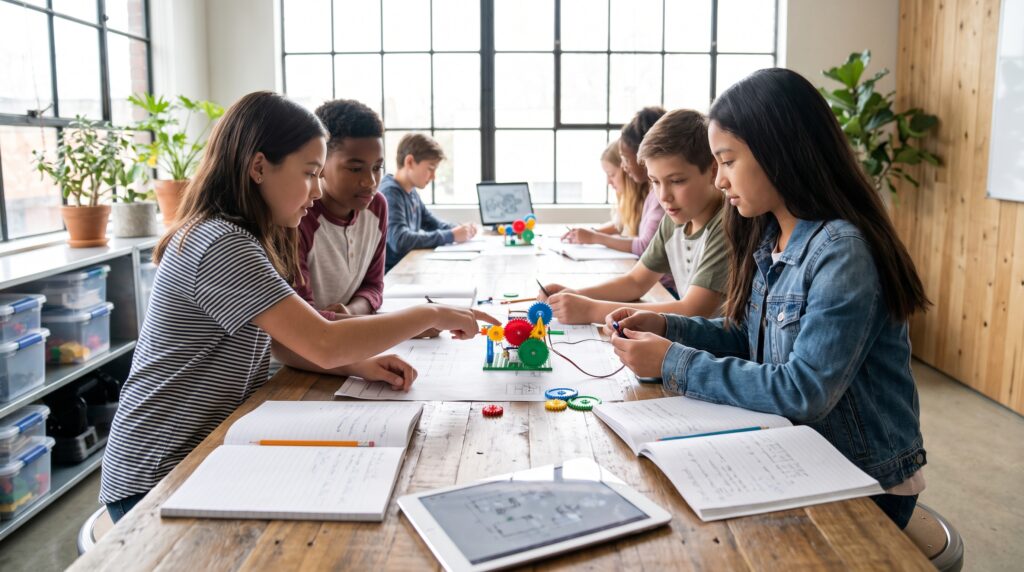
Many K–12 districts are taking a hard look at the all-digital classroom. Software and laptops make grading and distribution easy, but when students spend all day staring at screens, attention wanes and real comprehension takes a hit. That is why so many schools are shifting toward hybrid project-based learning (PBL). By combining tangible project based learning materials (like robotics kits, building supplies, and printed student workbooks) with an online learning portal, educators give students the hands-on practice they need without losing the convenience of digital tools.
What is Hybrid STEM Learning?
Hybrid STEM learning is an instructional model that combines hands-on engineering activities and physical paper workbooks with an online platform. Instead of forcing teachers to choose between isolated paper worksheets and all-digital screens, hybrid PBL blends both worlds. Students get the cognitive benefits of physically drawing schematics, taking notes, and assembling prototypes, while using digital tools for video tutorials, research, team collaboration, and automated rubric grading.
The Neuroscience of Tactile Note-Taking and Prototyping
Recent brain research and developmental psychology studies offer clear evidence for why physical handwriting and sketching still matter in STEM.
Neural Synchrony and Memory Encoding
Writing by hand lights up the brain’s sensorimotor and visual systems at the same time, coordinating physical hand movement, touch, and sight. An EEG study from the Norwegian University of Science and Technology, published in Frontiers in Psychology, found that handwriting produces significantly higher neural synchrony than typing on a keyboard. In particular, it boosts theta-band activity across the parietal and central areas of the brain. Theta waves are rhythmic electrical pulses that fire when the brain is actively absorbing, connecting, and locking in new information. When these parietal and central regions (which process sensory feedback and body movement) sync up, students build deeper, more durable memories of the material.
Visual Synthesis in STEM
STEM challenges often require students to map out logic paths, plan how components will move and connect, and sketch prototype iterations. Research in Instructional Science found that while typing on a laptop encourages students to copy down words mindlessly, taking notes by hand pushes them to draw concept maps, diagrams, and visual summaries. That physical sketching is essential for developing spatial reasoning and understanding how parts fit together.
Attention and Cognitive Load
A 2026 brain imaging study in Frontiers in Education (Shin et al.) showed that pen-based note-taking generates markedly higher alpha, beta, and gamma power in the occipital region (the visual processing hub at the back of the head) than working on a laptop. These frequencies indicate active, sustained visual focus, showing that students are genuinely paying attention rather than zoning out. Backing this up, a broad meta-analysis from the University of Nevada, Las Vegas covering 42 separate studies confirmed a clear recall advantage for students who write by hand compared to those who type.
The Complementary Value of Digital Management Platforms
Physical workbooks give students a distraction-free place to think and sketch, but digital platforms are where teachers manage workflow, media, and feedback.
Digital tools give classrooms access to interactive simulations, step-by-step video guides, and rich reference libraries that cannot fit in a printed booklet. As highlighted by EduDiv, online portals also support instant rubric grading, progress tracking, and timely teacher comments. Plus, students can easily record video walk-throughs of their physical inventions, log voice reflections, and share team portfolios.
Project Based Learning Platform With Print and Digital Workbooks
A project based learning platform with print and digital workbooks provides structured curriculum materials that combine physical design journals with an online hub for pacing, media submissions, and grading rubrics. For schools scaling PBL across multiple classrooms or grade levels, this dual format keeps instruction consistent without overburdening teachers.
iBlocks is built specifically around this dual-delivery approach. Rather than asking teachers to author multi-week PBL units from scratch in a generic LMS, educators can use the iBlocks search feature to browse dozens of ready-to-use curriculum pathways across grades K–12 by subject, academic standard, or classroom technology.
-
The Print Component: Full-color, grade-banded student workbooks guide learners step-by-step through the engineering design process, ideation, hand-drawn schematics, and physical prototyping without screen distractions.
-
The Digital Component: The companion iBlocks Online platform gives teachers centralized lesson pacing and student management. At the same time, students can submit milestone responses, upload build photos, link research sources, and review feedback against standards-aligned rubrics.
Conclusion
Pairing physical workbooks with a dedicated digital platform reduces screen fatigue while reinforcing retention through tactile writing and building. Bringing together physical sketching and digital management helps schools roll out project-based learning smoothly. As cognitive research highlights the benefits of handwriting and tactile design, hybrid learning offers a practical, grounded model for K–12 STEM education.
Ready to explore hybrid PBL for your district? Use the iBlocks search feature to browse customizable STEM pathways by grade and topic, or visit iBlocks.com to request a sample workbook and explore how iBlocks Online can support your classrooms.