NGSS and CSTA Alignment in PBL: Implementing 3-Dimensional Assessment and Capstone Rubrics
As school districts and state education agencies accelerate the integration of STEM disciplines in 2026, instructional coaches and curriculum directors face a critical challenge: ensuring project-based learning (PBL) curricula deliver genuine academic rigor. Evaluating whether a PBL unit meets dual requirements for science and computer science standards requires looking past surface-level engagement. A rigorous curriculum must intertwine the Next Generation Science Standards (NGSS) and the recently updated CSTA K–12 Computer Science Standards. By utilizing a complex interdisciplinary engineering challenge—such as designing an automated Rube GoldbergTM mechanism—educators can architect instructionally embedded, standards-validated capstone assessments.
What is 3-Dimensional Assessment in Project-Based Learning?
Three-dimensional (3D) assessment is an instructional framework that simultaneously measures a student’s proficiency across three distinct domains of science education. According to the National Research Council (NRC) Framework for K–12 Science Education, genuine scientific literacy requires the integration of Disciplinary Core Ideas (DCIs), Science and Engineering Practices (SEPs), and Crosscutting Concepts (CCCs).
To effectively measure 3D learning in a PBL environment, curricula must utilize Evidence-Centered Design (ECD). Pioneered by researchers at SRI International and the Stanford NGSS Assessment Project (SNAP), ECD ensures that every task elicits specific, observable evidence of multidimensional knowledge.
In high-quality PBL curricula, traditional linear grading is replaced by phenomenon-anchored challenges. The Strengthening Claims-based Interpretations (SCILLSS) Project notes that assessing these domains requires multi-component prompts where students cannot succeed through rote memorization. As researchers from SRI International note: “Principled assessment design requires articulating learning performances… ensuring that every capstone task and rubric feature elicits direct, observable evidence of student mastery.”
Aligning PBL with 2026 CSTA Computer Science Standards
Computer science is rapidly shifting from an isolated elective track to a core component of interdisciplinary STEM. As outlined in the 2026 CSTA PK–12 Computer Science Standards, modern PBL units must seamlessly embed computational thinking alongside traditional science instruction.
Integrated PBL leverages the symmetry between the NGSS Engineering Design Process (ETS1) and CSTA Computational Thinking Practices. Successful implementations focus on four core strands:
-
Algorithms and Programming (AP): Constructing iterative control structures, parameterizing functions, and executing systematic debugging.
-
Computing Systems (CS): Integrating hardware components like actuators and microcontrollers with software routines.
-
Data and Analysis (DA): Collecting telemetry from sensors and transforming input values into operational variables.
-
Impacts of Computing (IC): Employing team-based project management, version control, and ethical design considerations.
Step-by-Step Exemplar: Designing an Automated Rube GoldbergTM Task
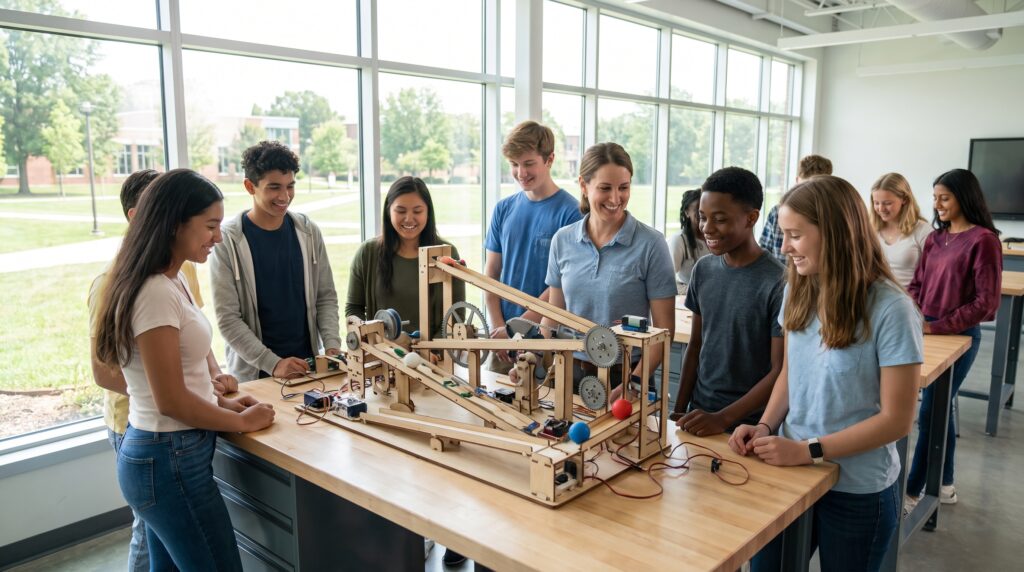
An exemplary capstone project that unifies physical science, engineering design, and computational thinking is an authentic Rube Goldberg task. In this challenge, students construct an elaborate, multi-step chain reaction to complete a simple end goal (such as watering a plant or releasing a latch).
Here is a guide to how a rigorous Rube Goldberg mechanism integrates both NGSS and CSTA standards across a three-stage progression:
Step 1: The Mechanical Stage (NGSS Focus)
Students design physical components utilizing simple machines and ramps. The focus is on energy transfer, specifically converting potential energy to kinetic energy.
-
Standard Alignment: NGSS MS-PS3-1 and MS-PS3-2 (Energy).
-
Actionable Evidence: Students must construct graphical models of kinetic energy relative to mass and speed, calculating thermal or sound dissipation losses during mechanical transfers.
Step 2: The Electro-Mechanical Stage (Cross-Curricular Synthesis)
The mechanism transitions from purely physical to electro-mechanical. For example, a rolling steel marble ultimately closes a physical circuit switch.
-
Standard Alignment: NGSS MS-PS3-3 and CSTA 2-CS-02 (Hardware and Software Integration).
-
Actionable Evidence: Students create annotated circuit schematics detailing how the physical event successfully triggers an electronic response.
Step 3: The Automated Microcontroller Stage (CSTA Focus)
A microcontroller reads the closed switch and runs conditional algorithmic code to trigger a servo motor, continuing the chain reaction automatically.
-
Standard Alignment: CSTA 2-AP-12 and 2-AP-13.
-
Actionable Evidence: Students design nested loops and compound conditionals (e.g., “IF the marble breaks the infrared beam AND the light sensor reads low, THEN activate the motor at 90 degrees”).
How to Implement Multidimensional Capstone Rubrics
Evaluating these complex intersections requires criterion-referenced, multidimensional rubrics compliant with the Achieve EQuIP Rubric for Science. Traditional compliance-based grading must be replaced with scales that measure simultaneous dimension mastery.
A proficient capstone defense for an automated mechanism requires specific evidence across categories:
-
NGSS DCI (Physical Science): The student accurately identifies and explains potential-to-kinetic energy transformations across each stage with clear causal logic.
-
NGSS SEP (Engineering Design): The student iterates mechanical components based on observed failure points and documents design adjustments across multiple trials.
-
CSTA Algorithms & Programming: The student successfully implements conditionals and loops to trigger electronic actuators based on physical sensor inputs.
-
Cross-Curricular Synthesis: The student delivers an articulate, evidence-backed technical defense explaining mechanical efficiency, code logic, and team iteration history.
Evaluating Turnkey PBL Solutions for District Scalability
Designing custom, standards-validated 3D capstone units requires hundreds of hours of curriculum mapping per teacher. To bridge this implementation gap in 2026, curriculum directors are turning to comprehensive systems like iBlocks (by Teq).
When evaluating turnkey PBL solutions, district leadership should utilize this strategic checklist:
-
Explicit 3D Element Tagging: Ensure instructional materials delineate exact bulleted elements of the DCI, SEP, and CCC within lessons, rather than merely listing broad standard codes.
-
Instructionally Embedded Formative Calibration: Look for embedded diagnostic rubrics that alert teachers to student misconceptions before the high-stakes final capstone build.
-
Turnkey Material Coherence: Validate that hardware, such as microcontrollers and simple machine kits, aligns perfectly with pre-written student workbooks and teacher guides.
-
Authentic Computational Problem-Solving: Verify that coding tasks interface with physical environments and scientific phenomena, moving beyond gamified on-screen coding exercises.
As an industry leader in K–12 Project-Based Learning Curriculum, iBlocks addresses these specific needs by providing pre-packaged, grade-sequenced units that seamlessly marry NGSS 3D learning performances with CSTA computational thinking benchmarks. By utilizing turnkey capstone evaluation frameworks and structured scoring guides, scalable solutions like iBlocks ensure that assessment integrity remains uniform across every classroom.
By insisting on multi-dimensional assessment and leveraging high-fidelity curricula, educational leaders can ensure their STEM programs provide rigorous, authentic preparation for the complexities of modern engineering and computer science.